Source: My Modern Met
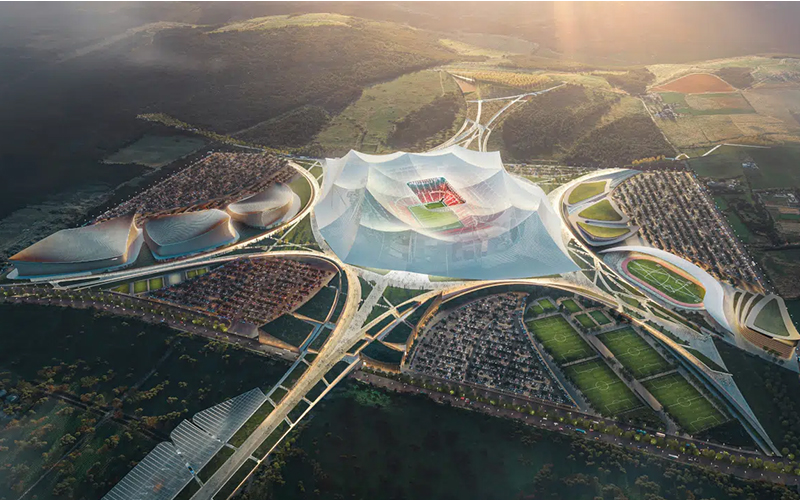
Morocco has started construction on Grand Stade Hassan II, a venue set to become the biggest football stadium anywhere on the planet. Built near El Mansouria, roughly 23 miles north of Casablanca, the project forms the centrepiece of the country’s bid to stage the final of the 2030 World Cup, a tournament it will co-host alongside Spain and Portugal, with select matches also played in South America.
For a nation making its first appearance as a World Cup host, this is an enormous statement of intent. Grand Stade Hassan II will hold 115,000 spectators, surpassing every existing football ground and placing Morocco in rare company when it comes to sporting infrastructure. The design, led by Populous alongside Paris-based practice Oualalou + Choi, leans heavily on Moroccan heritage rather than imitating the glass-and-steel bowls common across Europe.
A Design Rooted in Tradition
The architects took inspiration from the moussem, a traditional Moroccan festival built around vast tented gathering spaces. That heritage shows up in the stadium’s roof, a sweeping aluminium lattice canopy that reads as fabric from a distance despite being a rigid engineered structure. Thirty-two stairway towers support the canopy, each one topped with elevated gardens sitting more than 90 feet above ground level, framing the stadium like gateways rather than mere access points.
Green space is not limited to the upper platforms either. Planting at ground level, positioned beneath the canopy’s outer edges, is meant to give the whole venue the feel of an oasis, a deliberate contrast to the concrete austerity often associated with stadiums this size.
Among the notable features worth listing:
- A 115,000 capacity, the largest of any football stadium built to date
- A supporters’ section holding 29,500 fans across three steep tiers at each end
- Five tiers of hospitality seating along the main stands, totalling 12,000 premium places
- Thirty-two elevated stairway towers doubling as garden platforms
- An aluminium lattice roof canopy inspired by traditional moussem tents
Built for More Than One Tournament
While the World Cup final is clearly the ambition driving the timeline, Grand Stade Hassan II is not being built as a one-off showpiece. It is designed as the long-term home of the Morocco national team, alongside Casablanca clubs Raja CA and Wydad AC, two sides with fiercely loyal followings and a genuine claim to some of the most passionate matchday atmospheres in African football.
The surrounding development includes training facilities, aquatic centres, hotels and retail space, signalling that this is as much an urban regeneration project as a football stadium. El Mansouria, a relatively modest location by Casablanca’s standards, stands to be transformed by the scale of investment arriving alongside the stadium itself.
With FIFA yet to confirm the 2030 fixture schedule, Morocco’s bid for the final remains unresolved. But the scale and ambition of Grand Stade Hassan II leave little doubt about how seriously the country is pursuing it.