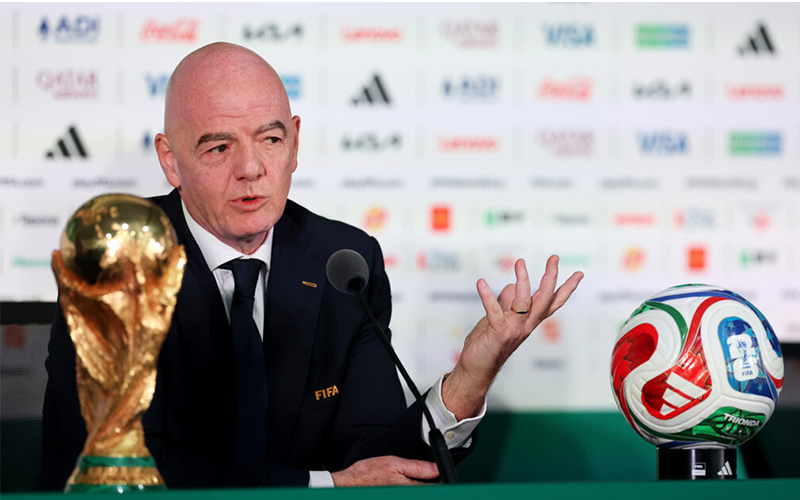
Source: @Getty
FIFA’s decision to review its disciplinary regulations after the Folarin Balogun suspension controversy has exposed a difficult question for football’s governing body: how much discretion should it have when enforcing the rules of its biggest tournament?
The Belgian Football Association (RBFA) confirmed that FIFA plans to amend Article 27 of its Disciplinary Code following criticism of the decision to suspend Balogun’s automatic one-match ban. The ruling allowed the United States forward to feature against Belgium in their World Cup last-16 meeting, despite his red card.
The proposed amendment is intended to address concerns over how FIFA exercises its power to suspend disciplinary sanctions in exceptional circumstances. The change still requires approval from the FIFA Council at its scheduled meeting in Doha on 16 December.
The Balogun case raises questions about consistency
Article 27 gives FIFA’s disciplinary authorities discretion to suspend the implementation of a sanction under exceptional circumstances. Such flexibility can be useful when a case warrants individual consideration, but it also creates room for questions when the governing body does not adequately explain why one player receives different treatment.
From a footballing perspective, the consequences extend beyond Balogun himself. A suspension can alter a team’s attacking options and affect the balance of a knockout match. Opponents must be able to trust that disciplinary decisions follow consistent principles, regardless of the player involved or the national team concerned.
The RBFA had sought an explanation from FIFA after expressing dissatisfaction with the reasons provided for applying Article 27. It also requested assurances that no outside party had interfered with the proceedings and called for national associations to have the right to be heard in comparable cases.
The controversy grew after US President Donald Trump said he had personally asked FIFA president Gianni Infantino to review the sanction. That intervention prompted further scrutiny of the independence of FIFA’s judicial bodies, although the Belgian federation reported that FIFA maintained its decisions were made independently.
Amending the regulation could help FIFA avoid similar disputes, provided the revised wording establishes firmer criteria for exceptional cases. Discretion should not become a convenient escape hatch from the rules that govern every competing nation.
The governing body now has an opportunity to get its house in order. If the revised article sets out how exceptional circumstances must be assessed and explained, it could strengthen trust in disciplinary decisions at future tournaments. Without meaningful safeguards, however, rewriting the regulation risks treating the symptoms rather than the underlying problem.