Source: @SAFA
South African football has moved closer to introducing Video Assistant Referee (VAR), but the technology will not become a regular feature of domestic competitions overnight. SAFA and the Department of Sport, Arts and Culture have outlined a revised set of priorities, with referee training now at the centre of the plan.
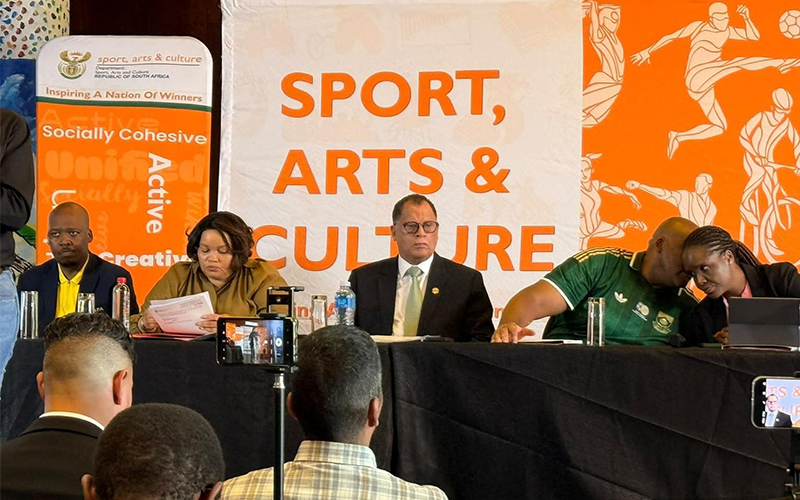
At a joint press conference at Freedom Park in Pretoria on Wednesday, 14 October, SAFA president Dr Danny Jordaan and Sports Minister Gayton McKenzie addressed the work still required to bring VAR to South African football. McKenzie indicated that the process was moving forward, with engagement with FIFA scheduled to help advance the project.
McKenzie has handed responsibility for the VAR rollout to SAFA. After initially seeking the return of the R20 million allocated to the project, the minister said he had examined SAFA’s bank statements and verified that the funds remained available. The department has allowed the project to continue under strengthened governance controls and reporting requirements.
SAFA submitted its detailed report to the Department of Sport, Arts and Culture on 9 September, outlining the reasons for the delay and its revised plans. The association was scheduled to meet FIFA on 15 October to seek approval for expanded referee training. The immediate target is now controlled trials in selected competitions, with the Nedbank Cup in 2027 among the possibilities, subject to the necessary approvals and agreement with the PSL.
Referee Training Takes Priority as SAFA Works Towards VAR Trials
SAFA began its VAR project in 2024 as part of a broader programme to develop referees and modernise the domestic game. According to CEO Lydia Monyepao, the original plan involved working with COSAFA, CAF and FIFA to develop local officials and prepare them for the demands of VAR-assisted matches.
The Department’s R20 million allocation has helped remove a major funding obstacle. However, public money cannot simply be spent on equipment while questions about procurement, technical readiness and operational costs remain unresolved.
A task team assessment in September 2026 identified several issues that need attention. These include the compatibility of VAR systems with existing broadcast facilities, the reliability of connections used for remote reviews, camera coverage and the communications equipment required by match officials. Maintenance and replacement costs also need consideration if the system is to remain viable over several seasons.
Agreement between SAFA and the National Soccer League (NSL), which operates the Premier Soccer League competitions, is another essential requirement. Broadcasters, including SuperSport/Canal+ and the SABC, must also be involved because VAR depends on suitable video feeds and technical coordination.
These requirements explain why purchasing equipment now would risk putting the cart before the horse. A system that works in one stadium or competition may not transfer easily to another without further investment and testing.
SAFA’s immediate priority is to expand its pool of trained officials. Eight South African referees have received VAR training through COSAFA, while Tom Abongile, Luxolo Badi and Akhona Makhalima have been approved to serve as referees, VARs and assistant VARs.
The full training and certification programme is expected to take approximately six months. It will include classroom instruction, simulator exercises and practical work on the field. SAFA was scheduled to engage FIFA from 15 October to seek approval to begin the next stage of referee training.
Jordaan has also argued that VAR could contribute to player protection. Video review can help officials identify serious incidents that escape their attention during live play. However, its effectiveness depends on consistent application of the laws, suitable camera coverage and well-trained personnel. VAR can assist referees, but it cannot eliminate every missed offence or prevent every injury.
The intended domestic competitions include the men’s Betway Premiership, the women’s Hollywoodbets Super League and selected SAFA tournaments. The ABC Motsepe League play-offs, SAFA Women’s Provincial League national play-offs and suitable cup competitions are among the potential environments for trials.
A controlled trial would give SAFA an opportunity to test the technology under match conditions and identify operational problems prior to any wider rollout. Full implementation will depend on FIFA approval, completed training, technical readiness, stakeholder agreement and a sustainable funding model.
For South African football, the next test is execution. SAFA and the ministry have set out the work ahead, but progress will ultimately be measured by whether the system can operate reliably across domestic competitions and deliver consistent support to match officials.