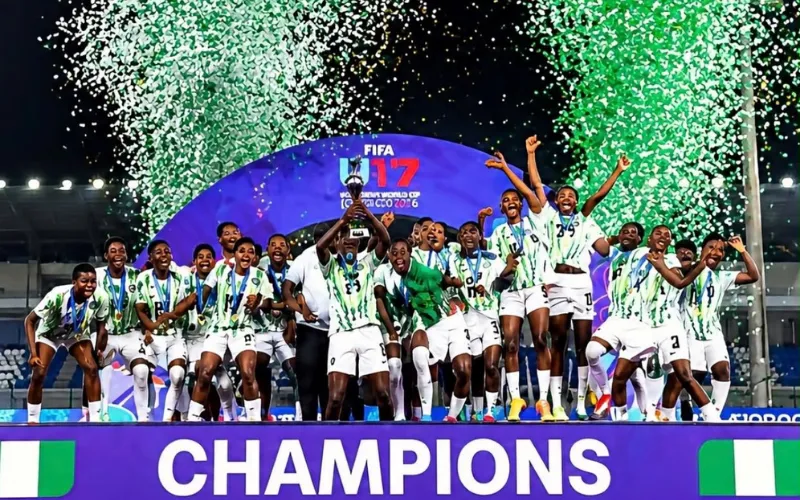
Source: @Supplied
For decades, the World Cup stories of African women’s teams have been told through lenses of raw potential – a narrative of a new dawn that seemed perpetually delayed.
Over the weekend, The Flamingos of Nigeria took flight into realms of immortality – securing Africa’s first-ever FIFA U-17 Women’s World Cup. At a time when Nigerian football was in administrative tatters, the young queens came to Morocco with a heavy mantle to bear, answering the doubts whispered in the football air.
Their relentless path to glory began with a painful opening-day 2–1 defeat to Poland. Refusing to yield, the Flamingos bounced back quickly to secure six consecutive victories. In one of the tournament’s biggest shockwaves, Nigeria stunned defending champions, Korea DPR. Guided by Coach Akeem Busari, the determined teenagers marched to the knockout stages and dared to dream; conquering giants like Mexico, Venezuela and Brazil before defeating an unbeaten, technically clinical Japanese squad in the final.
African Diamonds like Awawu Bashiru, Azeezat Oduntan, Queen Joseph and Golden Ball winner Oluebube Umejiaku unveiled a new reality where African teams do not just compete against the world’s best – they define the standard.
Across the continent, from the dusty pitches of Lagos to grassy fields of Nairobi, millions of young girls watched Umejiaku’s winner hit the back of the net and envisioned what their futures could be. That moment told every girl running in the streets of Africa with worn-out boots that their dreams are valid and that their place is on the world stage. The Flamingos did not just win the World Cup; they unlocked the shackles of limitation for a whole generation of African women.
The standard has certainly shifted; the boundary lines are gone. The wings of African football have officially taken permanent flight.