Source: @Tempo
The race to host the FIFA World Cup 2030 final has taken an increasingly political turn, with Spain and Morocco making increasingly forceful claims to football’s biggest occasion. What began as competition between two ambitious co-hosts now threatens to become a source of tension within the joint hosting agreement.
Morocco, Spain and Portugal were appointed as tournament hosts, with three centenary matches also scheduled for Uruguay, Argentina and Paraguay. However, the question of where the final will be played remains unresolved, and recent comments from Spanish opposition leader Alberto Núñez Feijóo have raised the stakes considerably.
Morocco has put forward the proposed Hassan II Stadium in Benslimane, near Casablanca. With a planned capacity of approximately 115,000, the venue would become the world’s largest football stadium if completed to its current specifications. Construction is expected to finish in 2029, giving the North African nation a major opportunity to present its hosting credentials.
Spain has two heavyweight contenders of its own. Real Madrid’s Santiago Bernabéu holds approximately 83,000 spectators, while Barcelona’s renovated Camp Nou is expected to accommodate around 105,000. Both venues offer established infrastructure and considerable experience hosting major football occasions.
Spain’s political threat raises the stakes
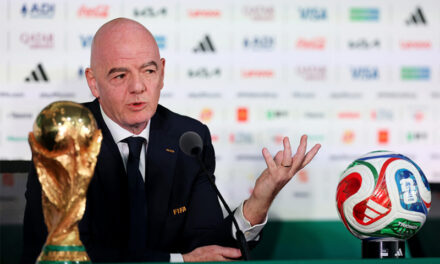
The strongest reaction has come from Feijóo, leader of Spain’s conservative People’s Party and a leading candidate in the country’s 29 November general election. During an appearance on Spanish television programme El Chiringuito, he argued that Spain should host the final and threatened to withdraw the country from organising the tournament if Morocco received the fixture.
His position goes further than a declaration of national preference. A Spanish withdrawal would place the entire three-country hosting arrangement under pressure, potentially forcing FIFA to reconsider its tournament planning. Feijóo has made his position explicit, although any decision would depend on his political success and subsequent government action.
Prime Minister Pedro Sánchez has also backed Spain’s candidacy, while Spanish Football Federation president Rafael Louzán and national team coach Luis de la Fuente have publicly supported a final on Spanish soil. The issue has therefore attracted support across several parts of the country’s football and political establishment.
Morocco, meanwhile, has shown little appetite for conceding the race. Royal Moroccan Football Federation president Fouzi Lekjaa has publicly backed Benslimane, while the country’s investment in the Hassan II Stadium forms a central part of its ambitions.
FIFA has refused to endorse either country’s claims. Its venue assessment programme will run through November and December 2026, with inspections covering candidate cities, stadium facilities, transport networks and supporting infrastructure. Barcelona’s Camp Nou is among the venues under assessment.
For FIFA, awarding the final requires more than satisfying the ambitions of either co-host. Stadium capacity, operational readiness, commercial considerations and the interests of all three organising nations will enter the equation.
The political temperature may continue to rise ahead of Spain’s election, but neither country can claim victory yet. FIFA has the final say, and its decision could test the partnership responsible for delivering the 2030 tournament.