Source: @Olympics/Getty
The early stages of a UEFA Champions League season can produce plenty of noise, but genuine records are harder to manufacture. They require elite production over time, extraordinary scoring rates or a moment that has never occurred in the competition before.
The opening fixtures of the 2026-27 UEFA Champions League have already delivered all three. Take a look below.
Harry Kane joins an elite scoring club
Kane’s header against Bodø/Glimt was more than Bayern’s second goal in a 5-0 victory.
It extended his scoring run to eight consecutive Champions League appearances, making him only the fourth player to reach that mark. Cristiano Ronaldo, Robert Lewandowski and Ruud van Nistelrooy are the other three names on the list.
The context makes Kane’s achievement even more impressive. Scoring once in eight straight Champions League matches requires consistency across different opponents, game states and tactical demands. It is also a record based on appearances rather than consecutive calendar dates, meaning the streak can survive the gaps between European fixtures.
Kane now has 55 Champions League goals and is already among the competition’s leading English scorers. More importantly, he has placed himself alongside three forwards whose European records have stood for years.
The next test is whether he can push the sequence beyond eight.
Mbappé reaches Raúl’s historic total
Mbappé’s 71st Champions League goal came in Real Madrid’s 2-1 win over Inter Milan and moved him level with Raúl in fifth place on the competition’s all-time scoring list.
The remarkable part is not simply the total. Mbappé reached 71 goals in 99 appearances, while Raúl needed 142 matches to reach the same figure.
That difference tells us plenty about the Frenchman’s scoring rate. He has scored at least four Champions League goals in every season since making his debut with Monaco in 2016/17, and his latest goal means only Cristiano Ronaldo, Lionel Messi, Robert Lewandowski and Karim Benzema have scored more than him.
At 27, Mbappé is also operating in a statistical territory normally associated with the final stages of a striker’s career. The bigger question now is how far up the list he can climb.
Haaland’s numbers continue to defy normal standards
Haaland’s Champions League record has become almost difficult to contextualise.
His two goals against Porto took him to 59 goals in 59 appearances in the competition. That gives him a goal-per-game ratio of exactly 1.00, while also placing him eight on the all-time scoring list.
He also moved level with Sergio Agüero on 36 Champions League goals for Manchester City, meaning he now shares the club record for most goals in the competition.
There is a useful comparison here with Mbappé. Both are progressing rapidly up the all-time rankings, but their records have developed differently. Mbappé has combined longevity with elite production, while Haaland’s extraordinary rate has allowed him to accumulate 59 goals in remarkably few matches.
That is what makes the next few seasons fascinating from a statistical perspective. Haaland is already sitting among players who have had careers lasting well over a decade in the competition.
Bayern reach 900 European Cup and Champions League goals
Bayern Munich’s latest landmark was reached in fitting circumstances.
Jamal Musiala scored against Bodø/Glimt to register Bayern’s 900th goal in the European Cup and Champions League, a total built across the club’s long history in Europe’s premier competition.
Bayern entered the match on 899 goals, meaning Musiala’s strike became the number that took them to the landmark. The achievement reflects the scale of the club’s European record rather than one particular generation.
It also arrived during a match that underlined Bayern’s continuing strength in the competition. After a goalless first half, Musiala opened the scoring before Kane, Alphonso Davies and Michael Olise took the final score to 5-0. Bayern have now won their opening Champions League match in 23 consecutive seasons.
Sabah produce a remarkable debut record
Not every historic achievement in the competition is about goals.
Azerbaijani champions Sabah made their Champions League debut at Old Trafford and started with 11 players representing 11 different nationalities. It is the first time a team has fielded a starting XI made up entirely of players from different countries in the competition.
The XI included players from Azerbaijan, South Africa, Kazakhstan, Algeria, Poland, Uzbekistan, Croatia, Jamaica, Serbia, Nigeria and Rwanda.
Sabah ultimately lost 4-0 to Manchester United, but the result does not erase the unusual milestone. In fact, it says something broader about modern European club football. The Champions League is no longer simply a meeting place for the traditional football powers. Its squads increasingly reflect the global nature of the game, with players from a remarkable range of footballing backgrounds sharing the same dressing room.
PSG begin their title defence as only the second repeat winner
Paris Saint-Germain enter this season carrying a rare piece of recent Champions League history.
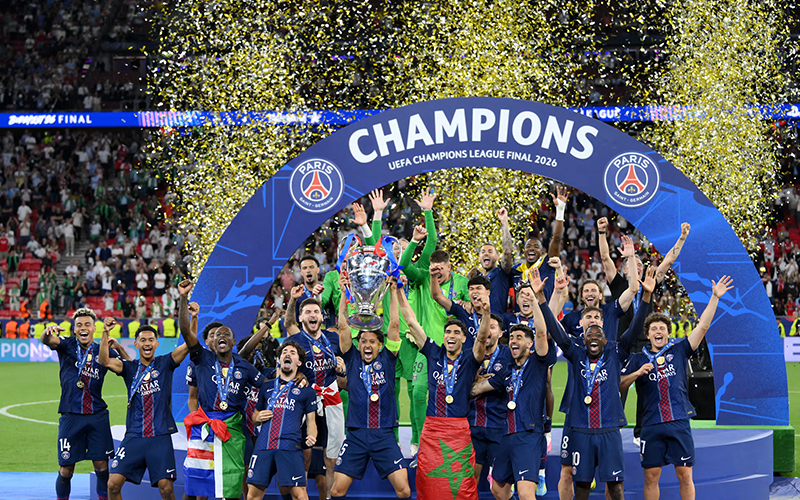
After beating Arsenal on penalties in the 2025/26 final in Budapest, PSG became only the second club to retain the Champions League trophy in the modern UEFA Champions League era, joining Real Madrid. Madrid achieved the feat in 2017 and 2018.
That makes PSG’s current campaign more interesting than a standard title defence. They are not simply trying to win the competition again. They are attempting to become the latest club to extend one of the rarest achievements in the modern era.
The league phase also brings a different test. The competition now features 36 teams, with each club playing eight league-phase matches before the knockout places are decided.
What comes next in the 2026-27 UEFA Champions League?
The league phase began on 8 September and runs through to 27 January 2027, with eight matchdays spread across that period. The knockout phase follows, with the final scheduled for 5 June 2027 at the Estadio Metropolitano in Madrid.
That leaves plenty of room for the current records to move again.