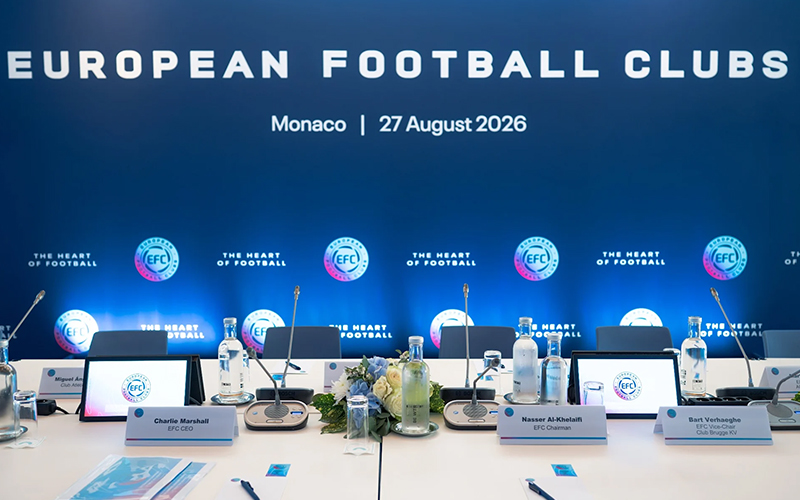
Source: @EFC
European Football Clubs (EFC) has spent the past few years becoming much more than the organisation formerly known as the European Club Association. Its membership has grown to 920 clubs across 55 countries and territories, and its influence now reaches well beyond discussions about European competitions.
At its General Assembly in Copenhagen on 29 September, EFC chairman Nasser Al-Khelaïfi took the next step by announcing a feasibility study into a potential global organisation for clubs, provisionally referred to as World Football Clubs.
The idea would give clubs a collective institution operating across the six continental confederations. It is still an early proposal rather than a fully established body. EFC has yet to set out its membership rules, legal status, governance model or precise relationship with FIFA. That leaves plenty of work to do, but the direction of travel is easy to identify.
Why EFC is looking beyond Europe
The modern football club has become a global institution even when its competitions remain rooted in a particular country or continent.
A leading club can have players from several continents, supporters spread across dozens of countries, commercial partners operating internationally and owners with interests far beyond domestic football. The same club can release players for a World Cup, compete in a continental competition and market itself to supporters thousands of kilometres from its home stadium.
The 2026 World Cup provided a useful measure of the clubs’ contribution to international football. Al-Khelaïfi noted that 857 players at the tournament came from European clubs, accounting for nearly 70% of the players at the 48-team competition.
That creates an obvious institutional question. National teams sit within FIFA’s system, while continental competitions sit under the confederations. Clubs, however, are central to the development, employment and release of the players who make those competitions possible.
EFC already represents European clubs in discussions with UEFA and FIFA. A global body would take that principle into a much wider arena, giving clubs outside Europe a formal collective platform of their own.
The idea also arrives at a time when the relationship between clubs and football’s governing institutions is being tested from several directions. Issues around player release, competition calendars, commercial rights, financial regulation and the distribution of revenue increasingly involve interests that cross national and continental boundaries.
A global clubs organisation would therefore sit in a very different place from a traditional league association. Its membership could span clubs with vastly different financial resources, sporting ambitions and domestic circumstances. Finding common ground between a European giant, an African powerhouse, a South American institution and a club from a smaller Asian league would be the real test.