Source: @CAF
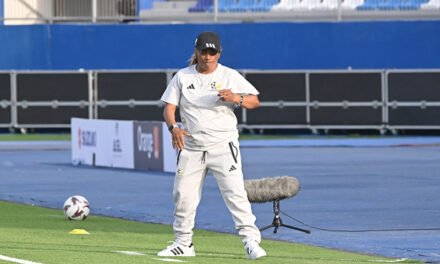
Pitso Mosimane is officially back in charge of Bafana Bafana, ending weeks of uncertainty over who would succeed Hugo Broos. SAFA confirmed his appointment on Tuesday, 1 September, more than three weeks after its National Executive Committee backed him as its preferred candidate.
The appointment feels very different from Mosimane’s first spell. When he took charge permanently in 2010, he was still establishing himself at the highest level. He returns now as one of the most decorated South African coaches in African football, having won the CAF Champions League with Mamelodi Sundowns and twice with Al Ahly.
His record with Bafana also carries some unfinished business. His first permanent tenure ran from 2010 to 2012 and ended after South Africa failed to qualify for the 2012 Africa Cup of Nations. That episode has followed Mosimane for years, but the coach who returns to the national team has accumulated a completely different level of continental experience since then.
The timing of his return also means he cannot spend months gradually imposing his ideas. Bafana’s next competitive assignment is already approaching.
Mosimane inherits a Bafana side with a new benchmark
Broos leaves the national team in a stronger position than he found it. His five-year tenure included a bronze medal at the 2023 Africa Cup of Nations and, most significantly, South Africa’s first-ever appearance in the World Cup knockout stages. Bafana reached the Round of 32 at the 2026 World Cup after beating South Korea and drawing with Czechia before losing narrowly to Canada.
That gives Mosimane an unusual starting point. He is not taking over a team that needs rescuing. He is taking over a side that has recently established itself as a competitive international outfit and now has to maintain that level while adding his own tactical ideas.
The first test will come in the 2027 AFCON qualifiers. Bafana are scheduled to face Guinea at home and Eritrea away towards the end of September, leaving Mosimane with a short preparation window.
For a coach who has built his reputation on tactical organisation and demanding standards, the early squad selection will reveal plenty. Mosimane will have to decide how much of Broos’ structure he retains, which players remain central to the project and whether some of the country’s emerging talent can force its way into the team.
That is where his experience should be valuable. Mosimane knows the South African player pool, has worked extensively across African club football and has managed dressing rooms at clubs where expectations are far greater than simply winning the next fixture.
His return also gives Bafana a coach with considerable continental pedigree at a time when South Africa needs to compete consistently against Africa’s strongest nations. His two Champions League triumphs with Al Ahly and his 2016 continental title with Sundowns provide a body of experience few South African coaches can match.
The bigger question is how much of that experience can be translated into international football. Club coaches have weeks to prepare teams between fixtures. National coaches often have only a handful of training sessions. Mosimane therefore needs to build a system that players can absorb quickly rather than attempting to reproduce the detailed structures that defined some of his most successful club sides.
The appointment itself took longer than SAFA would have wanted. The NEC backed Mosimane on 8 August, but negotiations over the final agreement continued into the end of the month. With the confirmation now complete, the focus shifts from the appointment to football.
Mosimane returns with a formidable CV but also with the benefit and burden of history. He knows Bafana, knows what the job demands and knows that his previous tenure ended without an AFCON appearance.